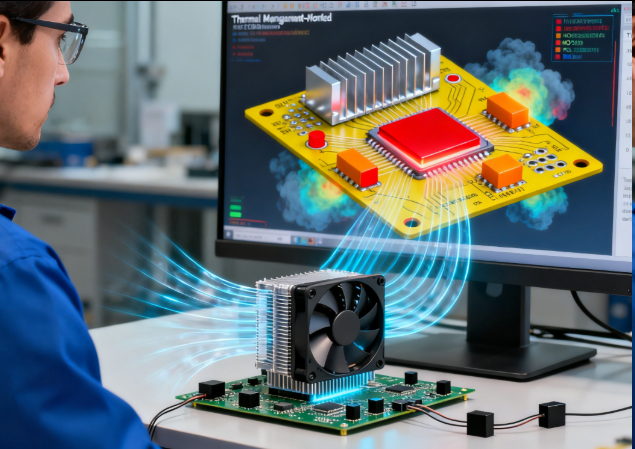
Thermal Management-Oriented PCBA Design is a design approach that optimizes
printed circuit board assemblies to dissipate heat efficiently, preventing
component overheating, which can cause performance degradation, shortened
lifespan, or catastrophic failure. Unlike designs that ignore thermal effects,
thermal management design identifies heat sources (e.g., high-power ICs, LEDs)
and implements strategies to transfer heat away from critical
components—critical for applications like power electronics, automotive,
industrial control systems, and high-performance computing (HPC) where
components generate significant heat.
The core of thermal management PCBA design lies in heat dissipation and
temperature control. Key technical strategies include: 1) Component Placement
for Heat Distribution: Placing high-power components (e.g., voltage regulators,
power transistors, LEDs) in low-temperature areas of the PCB—away from
heat-sensitive components (e.g., microcontrollers, sensors, batteries) and near
board edges or heat sinks (where heat can escape easily). Spacing high-power
components evenly across the PCB to avoid “hot spots” (areas with localized high
temperatures). For example, placing two 5W voltage regulators on opposite sides
of the PCB instead of adjacent to each other reduces their mutual heating by
15-20%. 2) Thermal Vias and Copper Pours: Using thermal vias (copper-plated
holes) to transfer heat from the top layer of the PCB to inner layers or the
bottom layer, where it can be dissipated more effectively. Thermal vias are
placed in clusters under high-power components (e.g., 4-8 vias under a voltage
regulator) and filled with solder or copper to maximize heat transfer. Adding
copper pours (large areas of solid copper) connected to ground or power
planes—copper is an excellent heat conductor, so pours spread heat across the
PCB, reducing hot spot temperatures. For example, a 1oz copper pour under a 10W
LED can reduce its temperature by 25-30°C. 3) Heat Sinks and Thermal Interface
Materials (TIMs): Integrating heat sinks with high-power components—attaching
passive heat sinks (aluminum or copper) directly to component packages using
TIMs (e.g., thermal grease, thermal pads) to fill air gaps and improve heat
transfer. For very high-power components (e.g., 20W+), using active cooling
(e.g., small fans or heat pipes) to enhance heat dissipation. Ensuring heat
sinks are compatible with the PCB’s mechanical design—avoiding interference with
other components or the device enclosure. 4) PCB Material and Copper Thickness:
Selecting PCB materials with high thermal conductivity—using metal-core PCBs
(MCPCBs, with a aluminum or copper core) instead of standard FR-4 for high-power
applications like LED lighting. MCPCBs have thermal conductivity 5-10x higher
than FR-4, enabling faster heat dissipation. Increasing copper thickness (e.g.,
2oz instead of 1oz) for power traces—thicker copper conducts heat better and
reduces resistive heating (I²R loss) in high-current traces.
Thermal management design requires thermal simulation early in the design
process. Engineers use thermal analysis tools (e.g., ANSYS Icepak, Mentor
Graphics FloTHERM) to model heat generation and dissipation, predicting
component temperatures and identifying hot spots. Physical testing with thermal
cameras (to visualize temperature distribution) and thermocouples (to measure
component temperatures) validates the design—ensuring all components operate
within their specified temperature ranges (e.g., -40°C to 85°C for industrial
components).
Application scenarios demonstrate thermal management’s impact. In power
electronics (e.g., electric vehicle (EV) inverters), thermal management PCBs use
MCPCBs, thermal vias, and heat pipes to dissipate heat from 100W+ power
transistors, ensuring reliable operation in the vehicle’s engine bay. In HPC
servers, thermal design uses copper pours, heat sinks, and active cooling to
keep CPUs and GPUs below 85°C, maintaining peak performance. In industrial
control systems (e.g., motor drives), thermal vias and evenly spaced power
components prevent overheating in factory environments with temperatures up to
60°C. In LED lighting, MCPCBs with copper pours reduce LED junction temperatures
by 30-40°C, extending LED lifespan from 50,000 to 100,000 hours. With
overheating being a leading cause of PCBA failure, thermal management design is
essential for delivering reliable, long-lasting products.




 Home >


