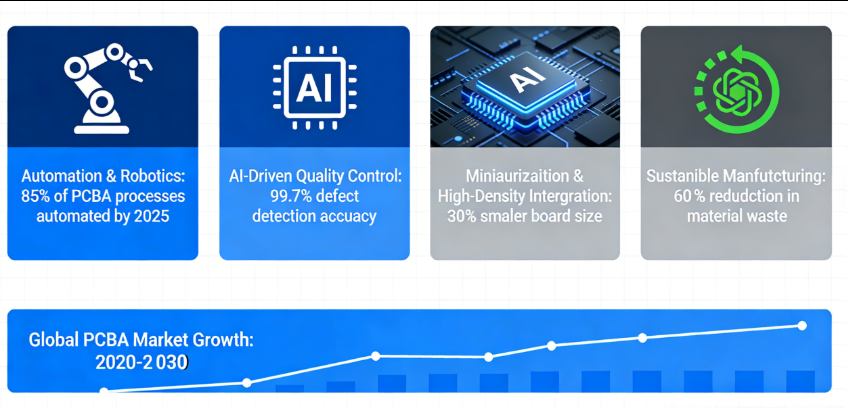
The PCBA industry is undergoing a profound transformation driven by smart manufacturing, which integrates advanced technologies to enhance precision, efficiency, and flexibility. As we enter 2026, the global SMT market is projected to exceed $90 billion, with a steady CAGR of 7% to 8%, fueled by the growing demand for smarter, more compact electronic devices across industries such as automotive electronics, AI, and 5G communications. A key trend is the widespread adoption of ultra-precise assembly technologies, including 01005 component mounting and POP (Package on Package) stacking, which enable higher component density and miniaturization—critical for smart wearables, high-end sensors, and ADAS (Advanced Driver Assistance Systems) in electric vehicles.
Another defining feature of smart manufacturing PCBA is the integration of AI, IoT, and automation. High-speed pick-and-place machines with micron-level accuracy, paired with AI-powered quality control systems, reduce defects by up to 30% and achieve 99.7% precision in detecting anomalies like cold joints or tombstoning. Predictive maintenance, enabled by IoT sensors that monitor machine vibration and thermal data, forecasts equipment wear 200-400 operating hours before failure, minimizing unplanned downtime and optimizing production efficiency. Additionally, flexible manufacturing models—combining mass production lines with dedicated prototyping lines—solve the industry pain point of "large factories refusing small samples and small factories lacking precision," catering to the rising demand for high-mix, low-volume production.




 Home >


