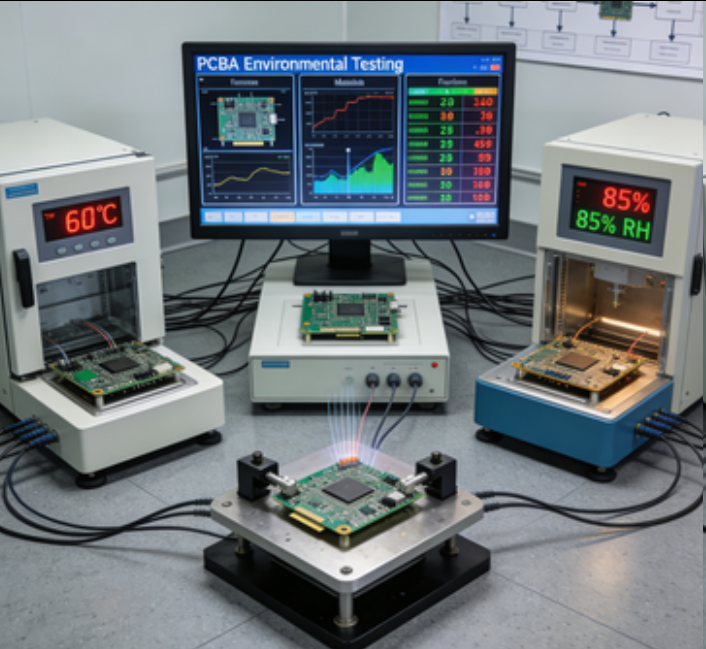
PCBA Environmental Testing is a specialized reliability evaluation process that exposes Printed Circuit Board Assemblies (PCBAs) to simulated real-world environmental conditions—such as extreme temperatures, humidity, vibration, shock, and chemical exposure—to validate their performance and durability under harsh or variable operating environments. Unlike aging tests that focus on long-term stress, environmental testing targets the PCBA’s ability to withstand specific environmental stressors it may encounter during transportation, storage, or end-use. This makes it critical for industries like automotive (where PCBAs face temperature swings and vibration), aerospace (extreme cold and radiation), industrial (dust and chemical exposure), and consumer electronics (humidity and accidental drops).
The core methodology of PCBA Environmental Testing follows standardized protocols (e.g., IEC 60068, MIL-STD-883) to ensure consistency and comparability. Key test types include: Temperature Testing (both high and low temperature), where PCBAs are exposed to extreme temperatures (-55°C to 125°C) for extended periods to assess component stability—for example, high-temperature testing checks if solder joints melt or capacitors leak, while low-temperature testing verifies if plastic components become brittle or solder joints crack. Humidity Testing (e.g., IEC 60068-2-38), which combines high temperature (40–85°C) and high humidity (60–95% RH) to simulate tropical or damp environments, accelerating corrosion of metal pads, insulation breakdown, or moisture absorption in ICs. Vibration and Shock Testing, where PCBAs are subjected to mechanical vibrations (sinusoidal or random) or sudden shocks (drop tests) to replicate transportation or use-related impacts—this detects loose components, cracked solder joints, or damaged connectors. Chemical Testing, which exposes PCBAs to oils, solvents, or cleaning agents common in their end-use environment (e.g., automotive fluids or industrial cleaners) to check for component degradation or solder joint weakening.
During testing, PCBAs are continuously monitored using electrical test equipment (multimeters, oscilloscopes, or functional test fixtures) to track parameters like resistance, voltage, current, and functional output. Any deviation from baseline performance (e.g., increased resistance in a circuit, intermittent signal loss) indicates a failure, and the PCBA is then analyzed to identify the root cause (e.g., corroded traces from humidity, broken wire bonds from vibration).
Practical benefits of PCBA Environmental Testing include mitigating field failure risks, ensuring compliance with industry standards, and optimizing product design. For example, an automotive manufacturer testing a PCBA for a dashboard display can identify if temperature swings cause the display to flicker, allowing redesign of the PCB’s thermal management. For aerospace applications, radiation testing ensures that satellite PCBAs do not experience single-event upsets (SEUs) in space. While environmental testing adds upfront costs, it reduces long-term warranty claims and recalls—critical for safety-critical industries. For any PCBA intended for use in challenging environments, environmental testing is an essential step to ensure reliability and customer satisfaction.




 Home >


