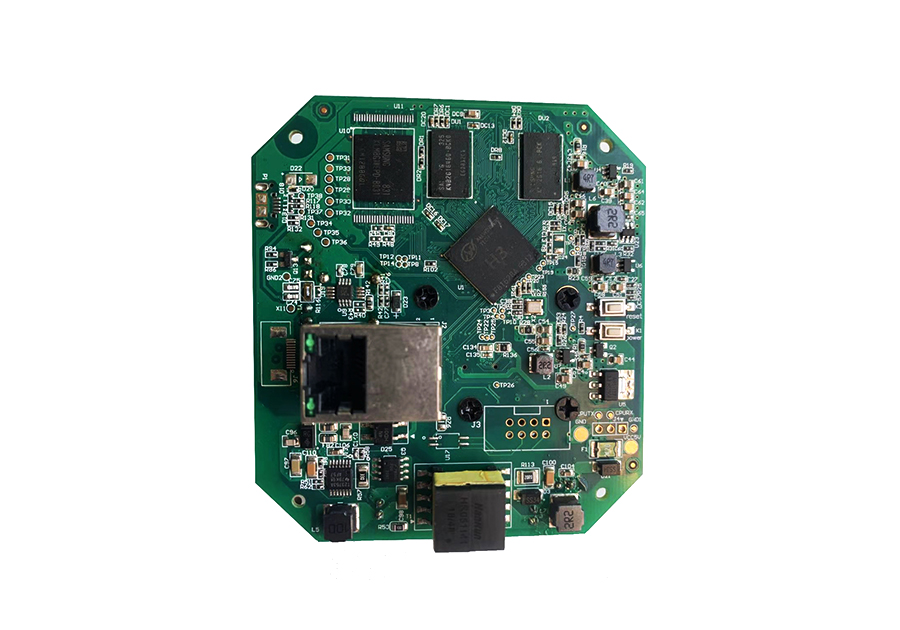
Multilayer printed circuit boards (PCBs) with buried resistors and
capacitors have emerged as a key technology for modern electronic design,
enabling more compact, high - performance, and reliable circuit assemblies.
Design Considerations for Buried Resistors
When designing a multilayer PCB with buried resistors, the first step is to
accurately determine the resistance values required for the circuit. The
resistance value of a buried resistor is determined by factors such as the
material of the resistive element, its dimensions (length, width, and
thickness), and the manufacturing process. For example, thin - film resistors
are commonly used for buried resistor applications. These resistors are
typically made by depositing a thin layer of a resistive material, such as
nickel - chromium alloy, on a dielectric substrate. The thickness of the
resistive layer and the width and length of the resistor pattern are precisely
controlled during the manufacturing process to achieve the desired resistance
value.
Another important design consideration is the placement of the buried
resistors within the PCB layers. They should be located in areas where they can
effectively perform their functions without interfering with other components or
signal paths. For instance, in high - speed digital circuits, buried resistors
may be placed near the source or load of a signal line to help control impedance
and reduce signal reflections. Additionally, the thermal management of buried
resistors needs to be carefully considered. Since they are embedded within the
PCB layers, heat dissipation can be a challenge. Designers may need to use
materials with good thermal conductivity in the vicinity of the buried resistors
or incorporate thermal vias to transfer heat away from the resistive
elements.
Design Considerations for Buried Capacitors
For buried capacitors in multilayer PCBs, the capacitance value is a
crucial parameter. The capacitance of a buried capacitor is determined by the
dielectric constant of the insulating material between the capacitor plates, the
area of the plates, and the distance between them. Common dielectric materials
used for buried capacitors include ceramic - filled polymers and high -
permittivity materials. Designers need to select the appropriate dielectric
material based on the required capacitance value and the electrical
characteristics of the circuit.
The layout of buried capacitors also plays a significant role in their
performance. In power - distribution networks, for example, buried capacitors
are often placed close to the power - consuming components to provide local
decoupling and reduce voltage fluctuations. They can help smooth out the power
supply and improve the stability of the circuit. Similar to buried resistors,
the placement of buried capacitors should avoid interference with other signal
lines and components. In high - frequency circuits, the parasitic inductance and
resistance associated with the buried capacitors need to be minimized. This can
be achieved through proper design of the capacitor's geometry and its connection
to the surrounding circuitry.
Applications of Buried Resistors and Capacitors
Buried resistors and capacitors find applications in a wide range of
electronic products. In smartphones, for instance, the use of multilayer PCBs
with buried components helps to reduce the overall size and weight of the device
while increasing the functionality. The compact design made possible by buried
resistors and capacitors allows for more components to be integrated into a
smaller space, such as in the motherboard of a smartphone. In high - performance
computing systems, buried resistors and capacitors can improve the signal
integrity and power - delivery efficiency. They can reduce the noise and
interference in the high - speed data - transmission lines and power -
distribution networks, ensuring the reliable operation of the system.
Additionally, in automotive electronics, where space is limited and reliability
is crucial, multilayer PCBs with buried resistors and capacitors are used in
applications such as engine control units and in - car infotainment systems to
enhance the performance and durability of the electronics.




 Home >


