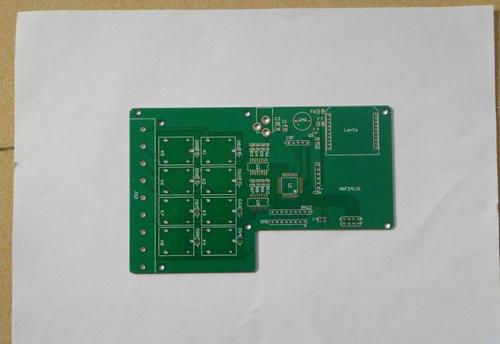
Custom Control Board PCBA refers to the personalized design and
manufacturing of Printed Circuit Board Assemblies tailored to specific control
system requirements—such as industrial equipment controllers, smart home control
panels, automotive electronic control units (ECUs), and medical device control
modules. Unlike standard off-the-shelf PCBs, it prioritizes functional matching
(aligning with the target device’s control logic), interface compatibility
(adapting to connected sensors/actuators), environmental adaptability (matching
the application’s operating conditions), and scalability (supporting future
function upgrades) to ensure the control system operates stably and
efficiently.
The core workflow of Custom Control Board PCBA includes demand analysis
& scheme design, PCB layout optimization, component customization &
sourcing, prototype manufacturing & verification, and mass production &
quality control. Demand analysis is the foundation: engineers collaborate with
clients to clarify core control functions (e.g., motor speed regulation, sensor
data acquisition, communication protocol support), performance indicators (e.g.,
response time ≤10ms, power consumption ≤5W), and application environments (e.g.,
-40°C~85°C for industrial control, 0°C~60°C for smart home). Based on this, a
technical scheme is designed—determining the main control chip (e.g., MCU like
STM32F4, DSP like TMS320), peripheral circuit architecture (power management,
signal conditioning, communication interfaces), and PCB layer count (2~8
layers).
PCB layout optimization focuses on control performance: key circuits (e.g.,
analog signal acquisition, PWM output for motor control) are isolated from
high-noise circuits (e.g., power modules, digital communication) to reduce
interference. For example, in an industrial motor control PCBA, the analog
current sampling circuit is placed away from the PWM output circuit, and
separate ground planes are used to avoid signal crosstalk—ensuring accurate
current detection and stable motor speed control. High-speed signal traces
(e.g., Ethernet for industrial communication) use controlled impedance design,
and thermal vias are added under high-power components (e.g., MOSFETs for power
conversion) to prevent overheating.
Component customization & sourcing ensures compatibility: for special
control functions (e.g., high-precision analog-to-digital conversion for sensor
data), customized components (e.g., 24-bit ADC chips) may be selected. Sourcing
prioritizes components with stable supply chains (to avoid production delays)
and reliable quality (e.g., industrial-grade components for harsh environments).
For example, a custom automotive control PCBA uses AEC-Q100-certified chips to
withstand high temperatures and vibrations.
Prototype manufacturing & verification is critical for risk control:
small-batch prototypes (10~50 units) are produced using quick-turn processes.
Verification includes functional testing (e.g., verifying motor speed regulation
accuracy, sensor data acquisition stability), environmental testing (temperature
cycling, vibration), and reliability testing (continuous operation for 100+
hours). Any issues (e.g., slow response, signal interference) are fed back to
the design team for optimization—for example, adjusting the MCU’s clock
frequency or adding filter capacitors to improve signal stability.
Mass production adheres to strict quality standards: automated
pick-and-place machines ensure component placement accuracy, and AOI/X-ray
inspection detects soldering defects. Each PCBA undergoes 100% functional
testing to ensure consistency with the custom control requirements. Traceability
is implemented via unique serial numbers, allowing tracking of component batches
and test results.
In practical applications, Custom Control Board PCBA enables precise
control of specialized devices. An industrial robot manufacturer uses a custom
control PCBA to implement multi-axis motion control, ensuring the robot’s
positioning accuracy reaches ±0.01mm. A smart home brand’s custom control panel
PCBA integrates Zigbee/Matter communication and touchscreen control, enabling
unified management of smart lights, curtains, and thermostats. For clients with
unique control needs, Custom Control Board PCBA provides a tailored solution to
achieve optimal system performance.




 Home >


